

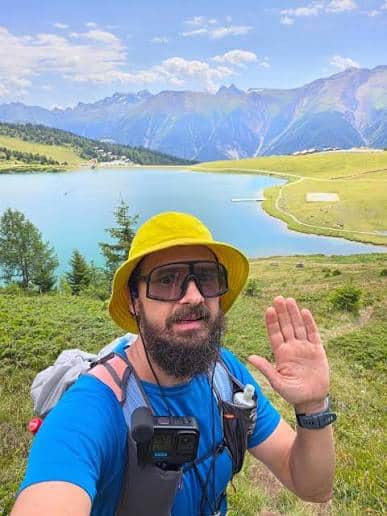
Somewhere deep into the Eiger 250, my legs had stopped being legs, I couldn’t keep any energy in me. Grindelwald was still more than a day away, and I wasn’t thinking about the finish at all. I was thinking about one thing: the next checkpoint and the possibility to get some sleep.
That’s the whole post, really. But it took me a few hundred kilometres and a company to understand it.
Strava tells me what I did. It doesn’t tell me why.
I’m a data person. After a long run I open the per-kilometre split table on Strava and go through it line by line: pace, grade-adjusted pace, elevation gain, heart rate. How did I do, and what can I learn from this to be better next time?
I love that data. It’s also completely silent on the stuff that decides whether I lace up again.
It doesn’t know if the route was fun. It doesn’t know if I’d run it again. It has no column for the light coming up over a glacier, or the ridge I didn’t know was there until I was standing on it.
Strava measures what you did. It’s very good at that. But measuring a run and having a reason to start one are two different problems. We built a company around the second one.
Watching is easy. Going out is the hard part.
Ultra races are great to watch now: live tracking, dot-watching, finish-line videos. I watch plenty of them.
None of it gets me out the door on a wet Tuesday in Espoo. What gets me out is a trail I haven’t run yet. A loop I’ve never done, a forest path I’ve only seen from the road. That’s curiosity, not motivation in the poster sense.
Why anyone runs 250 km
ABC recently published a piece on why people run ultramarathons and trail races, and it reads like a game design brief.
Sally Beggs, one of the runners in the article, says she “couldn’t even run to the mailbox” when she started. She went on to run the 50 km Grampians Peaks Trail race in a personal best of 10 hours 24 minutes. Ask her what she loves and she doesn’t mention pace. She says: “You never know what you’re going to see.”
John Claridge, president of the Australian Ultra and Trail Running Association, says in the same article that with terrain, weather and conditions all changing, success on the trail is often about completing a personal challenge, not where you place.
Take out the running and look at what’s left: discovery, a personal challenge, and people to do it with. That’s the core loop of nearly every game that holds people for years.
The Eiger 250 is a stack of small games
On paper the E250 is absurd. Organisers list it at about 250 km with about 18,000 metres of climbing. It starts and finishes in Grindelwald and loops around the UNESCO Swiss Alps Jungfrau-Aletsch World Heritage area. You get 95 hours, and you race in a team of two or three (Eiger Ultra Trail by UTMB).
Nobody can hold 250 km and 18,000 metres in their head. I can’t, and I tried.
What the race actually gives you is a series of checkpoints, each with its own deadline. Stechelberg closes 6 hours in, Kandersteg at 21, Finnen at 43, Bellwald at 64, Grimselpass at 76 and Geissholz at 86. The finish closes at 95 hours.
Each checkpoint works like a save point. You arrive, you reset, you eat, and you’ve won something small. Then the game restarts with a new target and a new clock.
My biggest checkpoint was Belalps. Before that I couldn’t keep almost any energy inside me. The journey had taken its toll and storm was closing. The storm hit us one kilometer before the checkpoint. If you haven’t experienced a lighting storm in the mountains, its quite humbling. We got in and we’re greeted with the smell of pizza and volunteers telling that they have warm beds ready for us. Shower, pizza and some sleep were all that it took to reset me. The storm also went away and we woke to a sunny morning.
18 hours later we were at a new checkpoint. We saw ten teams sleeping and decided to continue our journey without any more sleep. That was a mistake. It was dark, cold and rainy again. We tried to sleep on a concrete under a bridge, but there was too much wind coming from a close by mountain lake. We continued zombie walking to the next aid station, for maybe 10 hours. Or it felt like days.
But I was’nt alone, I had my friend Pekka with me. He kept me going and motivated me with stories of the delicacies waiting for us in the next checkpoint. I would have quit alone, but this was a team race, and Pekkas race would have been over too, if I quite. A team format turns a personal challenge into a shared one.
Nobody runs 95 hours in one go. You run to the next checkpoint, again and again. That’s a game loop.
What we build at Wandrio
When people ask what Wandrio is, the honest answer is that we took what kept me moving on the mountain and turned it into game mechanics for ordinary days.
- Checkpoints. Places to reach. Not “run 10 km,” but “get there.” A destination is easier to commit to than a number, the same way a checkpoint is easier than a finish line.
- Steady progress. Progress you can see, so every outing adds to something bigger than itself. A short walk still counts. On the E250, every checkpoint was progress you could bank. I want every trip out the door to feel like that.
- Finding new places. Sally Beggs’s line, “you never know what you’re going to see,” is pretty much our design principle. Discovery is the reward, and new ground is the content.
Where does this sit next to Strava? Right next to it. Strava records the run. Wandrio gives you a reason to start it. I use both, and I don’t see a conflict.
Curiosity beats willpower
Willpower is a finite resource. It runs out like a gel wearing off on the second night: one moment you have it, the next you’re bargaining with yourself.
Curiosity works differently. “What’s around the next bend?” refills itself every time you go around a bend. In my experience it keeps people moving far longer than “I have to.”
That’s why I don’t think ultra runners and gamers are different kinds of people. Both are wired to chase the next checkpoint, keep the streak going and see what’s past the edge of the map. The ultra runner just does it on foot, for a few days, with a lot of climbing.
Back on the mountain
Back to that moment on the Eiger 250. I didn’t get through it by thinking about Grindelwald or my splits. I got through it because there was a next checkpoint, it was close enough to believe in, and I wanted to see what was on the way.
That’s all I’m trying to build: a next checkpoint close enough to believe in, and a reason to want to see the way there.
So this week, skip the usual loop. Pick a trail you’ve never run, or a street you’ve never walked down, and go see what’s there.