

Tile hunting is simple: go outside, explore the world, and collect the map tiles you visit.
It is a hobby that we love and has taken us into crazy and exciting adventures. It has made us see the world on a new way. You are about join us on this tile hunting craze. Welcome aboard! Here is a 5 minute guide to get you started.
Wandrio turns everyday walks, runs, rides, hikes, and trips into an exploration game. Instead of always subconsciously taking the same route, you have a reason to explore new streets, trails, parks and neighborhoods.
If you’ve never tried tile hunting before, don’t worry. Its not very hard when you know what to do. And in the next five minutes, you will learn the core tile hunting loop:
Explore the World → Collect tiles → Connect them → Expand your area.
Minute 1: Open Wandrio and explore the map
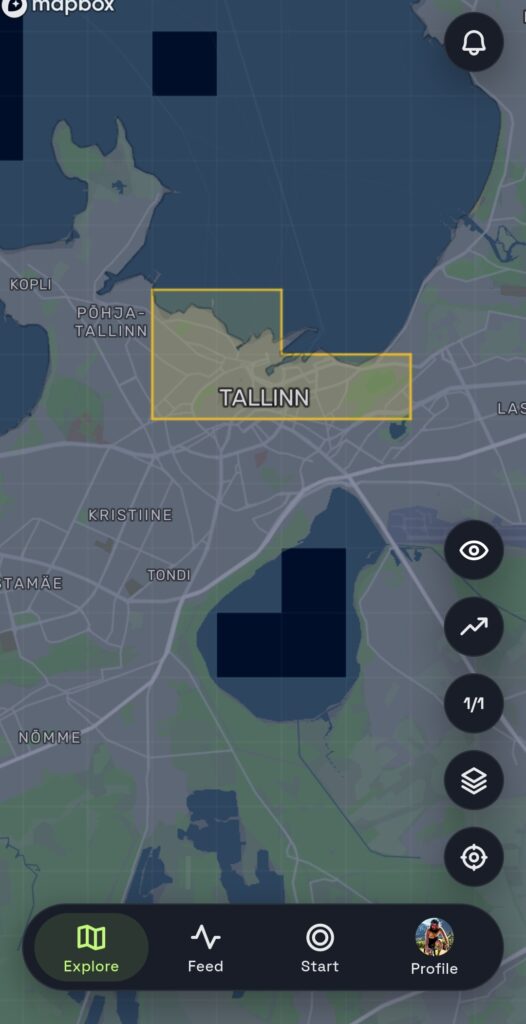
Open Wandrio and look at the map around you.
The world is divided into tiles. You can see tiles that you have already visited higlighted on the map, but most of the tiles will be unvisited and waiting to be explored.
Your first goal is easy:
Find a few nearby tiles you have not collected yet.
You do not need to travel somewhere special. Start close to home:
- Around your home or workplace
- Along your usual running or cycling route
- In a nearby park or forest
- On the route to the grocery store
- Around a school, station, beach, or neighborhood you pass often
Most people have plenty of unexplored tiles surprisingly close by.
For your first outing, ignore scores, rankings, and perfect shapes. Choose a place that looks interesting and aim for roughly 1-4 new tiles. If you are walking, aim for less tiles and if you are cycling, you can go further in your first adventures.
Minute 2: Go outside and collect your first tiles
Now, its time to get moving.
Start recording your activity in Wandrio by pressing the record-button in the map-screen. You can also collect tiles with a compatible Garmin-device or by connecting to Strava. But for the couple of first adventures we recommend using the native Wandrio-app, to get started easily.
When you start your recording and get moving, wandrio draws a line of your movement, based on your GPS-data. You can see it on real-time on the screen and easily navigate to new tiles.
You can collect tiles while:
- Walking
- Running
- Cycling
- Hiking
- Exploring a new city
- Taking the dog out
- Doing everyday errands
You do not need to make extra time for tile hunting. A normal 20-minute walk is great as your first tile-hunting adventure.
Walking to the store? Take one unfamiliar side street and collect some tiles.
Going for a run? Add a small loop through a nearby park.
Cycling to meet a friend? Ride one block further before turning.
Wandrio makes everyday movement part of your map.
Minute 3: Build your first cluster
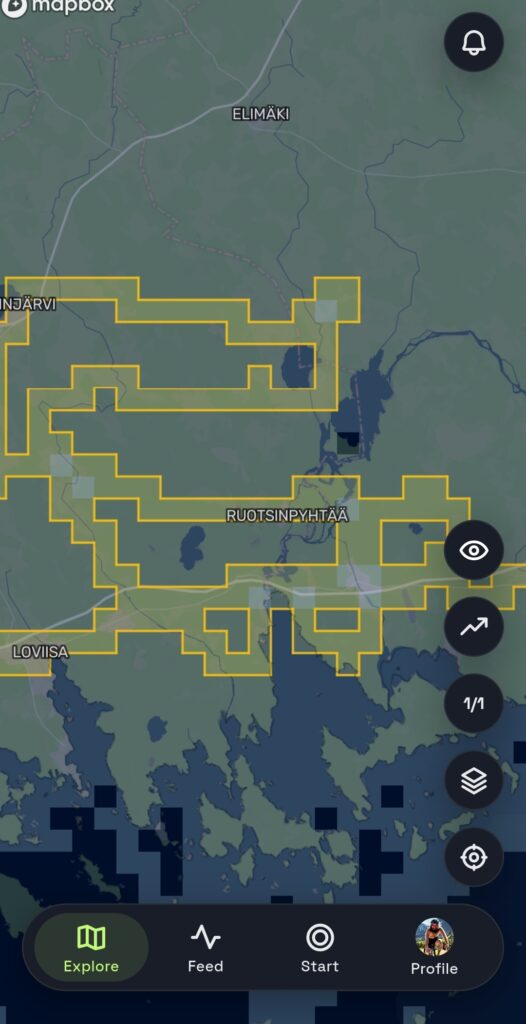
After collecting a few tiles and saving your activity, open your Wandrio-map again.
You will see your collected tiles scattered around the map. Some are connected to each other, but after couple of trips, you will see unconnected tiles or holes between otherwise perfect tile clusters.
This is where tile hunting starts to become satisfying: connecting tiles.
A cluster is a connected group of tiles. For example:
You already have a connected area, but the gaps stand out. Those empty tiles become natural targets for your next outing.
You may start thinking:
“If I walk down that street, I can connect these tiles.”
That is the shift from simply exercising to actively exploring.
Instead of asking:
“Where should I go for a walk?”
You begin asking:
“How can I make my map bigger? What route should I take to make my area bigger. How can I reach that tile in the woods?”
A good first challenge
Try to build a small connected area, such as:
- Make a cluster with 15 connected tiles.
- Make cluster that connects your home to your local store
- Connect your workplace to your home
You do not need to finish it in one day. The point is to learn the principle:
Do not only collect tiles, connect them and grow your area every day.
Minute 4: Work toward your first megatile
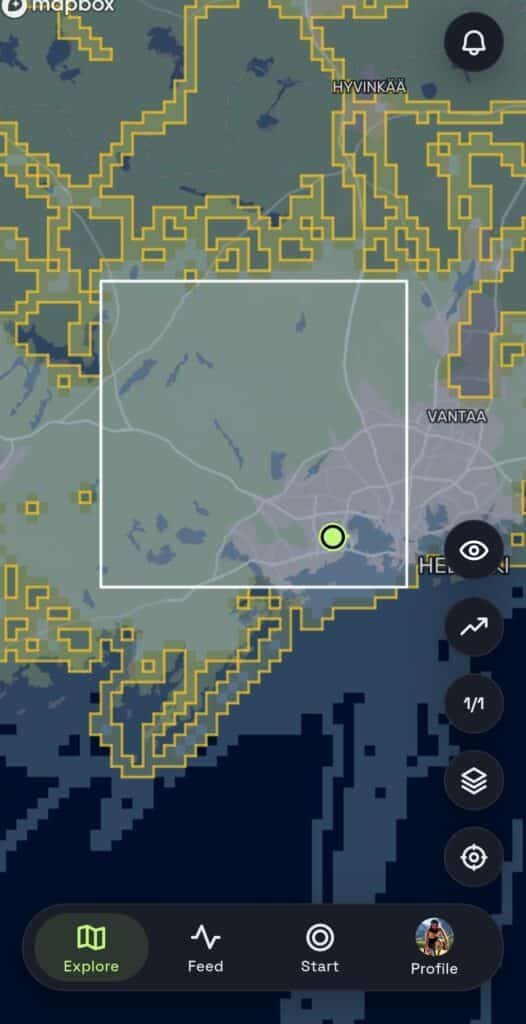
Once you have a small cluster, start thinking a little bigger.
Wandrio includes multiple tile levels, such as 1/1, 1/16, and 1/64 tiles. Larger areas are made up of smaller tiles, so systematically exploring an area can gradually lead to bigger achievements.
For a beginner, the easiest approach is to choose one realistic area and slowly cover it.
For example
- Build a 3×3 megatile
- Build a 5×5 megatile from microtiles
Rather than collecting scattered tiles across an entire city, pick a manageable target:
- Your home neighborhood
- A local park
- A nearby forest
- Your usual cycling area
- Trails around your favourite running route
- The area around a summer cottage or holiday destination
Your next walk might cover the northern edge. A cycling ride might fill the eastern side. A weekend hike might connect the remaining gaps.
Over time, separate outings become one larger explored area and eventually, your megatile will grow and grow. You will start spending time with route building and planning a weekend trip just to collect tiles.
Do not try to conquer everything
Looking at a large map can feel overwhelming. It is tempting to think:
“I need to collect the whole city.”
You do not.
Start small, finish a satisfying area, then expand outward. Your map becomes a personal exploration project, not an impossible checklist. You just need to do something little everyday.
Minute 5: Plan the next adventure
Before you close Wandrio, look at your map one more time.
Find a few tiles that would feel especially satisfying to collect next. The best targets are often close, visible, and easy to connect to your existing collection.
For example:
That one empty tile in the middle will probably start to bother you.
That is normal, and it is part of what makes tile hunting so compelling. An incomplete shape creates a gentle urge to finish it. Tomorrow, you may take a slightly longer route just to fill that gap.
Then you will spot another one.
That is how the game naturally grows.
Your first-week challenge
Use this simple seven-day plan to get started without overthinking it.
| Day | Goal |
|---|---|
| Day 1 | Collect your first 1–4 tiles. Focus only on learning the basics. |
| Day 2 | Expand your existing collection by collecting tiles next to ones you already own. |
| Day 3 | Take a different route than usual and explore a new street, trail, or park. |
| Day 4 | Work on a cluster by filling gaps or connecting nearby tiles. |
| Day 5 | Go a little farther away on a longer run, ride, walk, or hike. |
| Weekend | Choose one neighborhood, park, forest, or trail network and start building a larger explored area. |
The goal is not to create the biggest map in a week. It is to build the habit of looking at your surroundings differently.
Beginner mistakes to avoid
Do not obsess over score
At first, focus on understanding the map and enjoying the exploration. Scores, rankings, achievements, and larger objectives will make more sense once you have built a small collection.
Do not collect only random tiles
Random exploration is fun, especially in a new place. But connected tiles often feel more rewarding than the same number of isolated ones.
A map with a clear shape tells the story of where you have explored.
Do not always choose the shortest route
This is one of the biggest changes tile hunting can create.
If you always walk, run, or cycle along the same streets, ask yourself:
“What happens if I take the other street?”
That small detour might lead to a new park, quiet trail, viewpoint, café, shortcut, waterfront path, or neighborhood you would otherwise never notice.
Do not think you need to be an athlete
Tile hunting is for anyone who moves and likes discovering places.
A short evening stroll counts. So does a commute, a dog walk, a hike, a run, or a cycling trip across town.
The goal is not to be fast or competitive. It is to get outside and make the world around you feel more explorable.
Where it goes next
Once the basics click, Wandrio becomes deeper.
You can begin to:
- Build larger and cleaner clusters
- Fill gaps and complete local areas
- Work toward larger tile levels and megatiles
- Explore new cities and destinations
- Compare maps with friends
- Chase achievements, statuses, and challenges
- Plan runs, rides, or walks around areas you want to explore
Eventually, you may look at a large unexplored part of the map and think:
“I could get all of that.”
That is when you have become a tile hunter.
The golden rule
Do not make tile hunting complicated.
Open the map. Find an unexplored area. Go outside. Collect a few tiles. Come back and see what you want to explore next.
The best route is not always the fastest one.
It is the one that makes you think:
“I wonder what is over there?”